
A fantasy comedy co-produced by The Jim Henson Company and Queensland's Story Bridge Films. Two junior employees at a mysterious London firm discover their CEO is plotting to upend the ancient magical order — starring Christoph Waltz and Sam Neill.
Despite being set in England, the film was shot entirely in Australia, earning strong reviews upon release and MGM international distribution.
140+ VFX shots across five months — enchanted hair simulation, magical beam effects, creature augmentation, and a full suite of fantasy environment work.
/ Enchanted Hair — Rachel House's Character
One of the more genuinely unusual briefs we've had: create a head of hair that behaves like hair — moves like hair, sits like hair — but periodically arranges itself to spell the word "beware." It needed to feel organic, not mechanical. The kind of thing that reads as strange before the audience can quite articulate why.
The effect was built entirely in Houdini. We started with HairGen, using guide curves to define the base movement and direction of each strand — essentially building a skeleton for the sim before any dynamics entered the picture. Those prototype animated hairs were then fed into Vellum, Houdini's constraint-based solver, which handled the per-strand physics: how the hair responds to gravity, momentum, and the character's own movement. Vellum runs each strand as a series of constraints rather than a rigid chain, which gives you that subtle, unpredictable quality that makes hair look real rather than simulated.
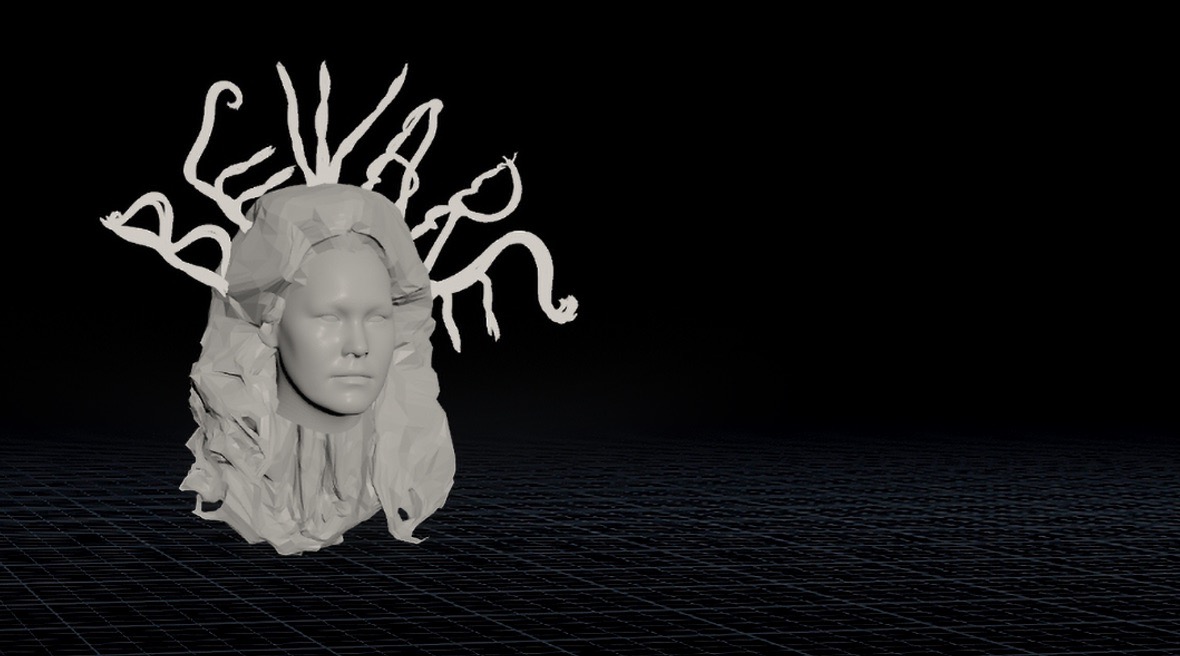
Once the sim was locked, the strands were point-deformed back onto the original guide curves — keeping the performance intact while layering the physical behaviour on top. The final renders went to compositing to be integrated back into the plate, matching the on-set lighting and blending seamlessly with the practical hair elements already captured in camera.
/ Magical Beams — Christoph Waltz's Characters
Christoph Waltz plays two characters in the film, both of whom wield magic — which meant designing a visual language for how that magic looks and moves. The brief was energy: something between electricity and light, with an internal logic that felt deliberate rather than arbitrary.
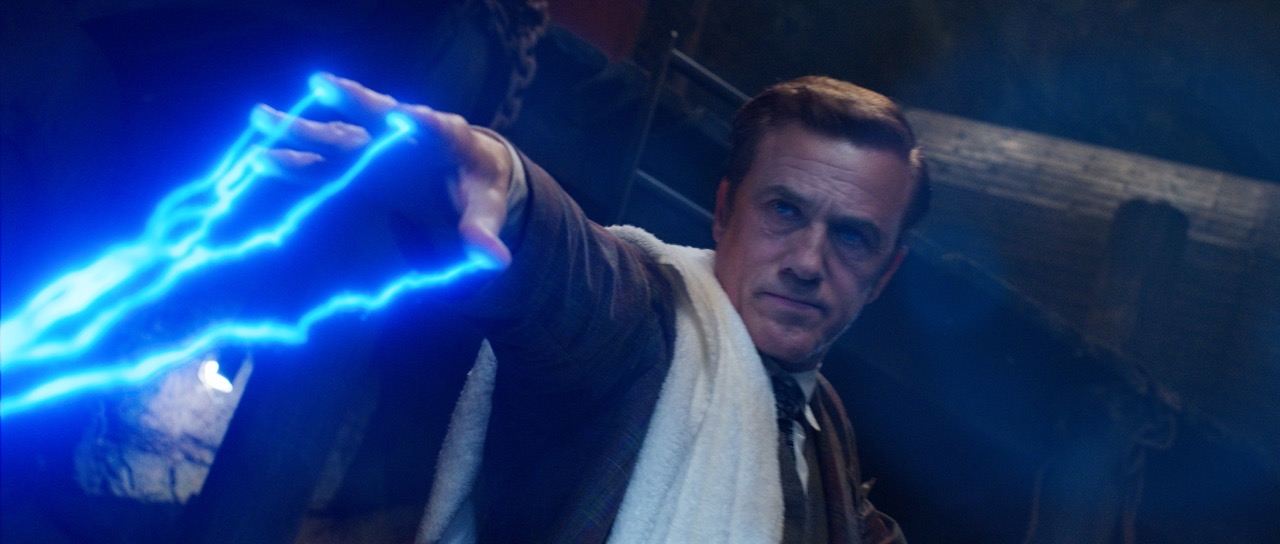
The beam effects were built using a combination of POP and Pyro simulations in Houdini. The path of each beam was established by drawing a curve between two points in the scene — giving us spatial control over the trajectory before any simulation ran. Custom noise was then applied along the curve to break up the line and give it that unstable, charged quality. From there, a scattered particle simulator emitted moving points along the curve's path, producing the pulsing, lightning-like energy effect visible in the final shots. The result reads less like a light beam and more like something barely contained.
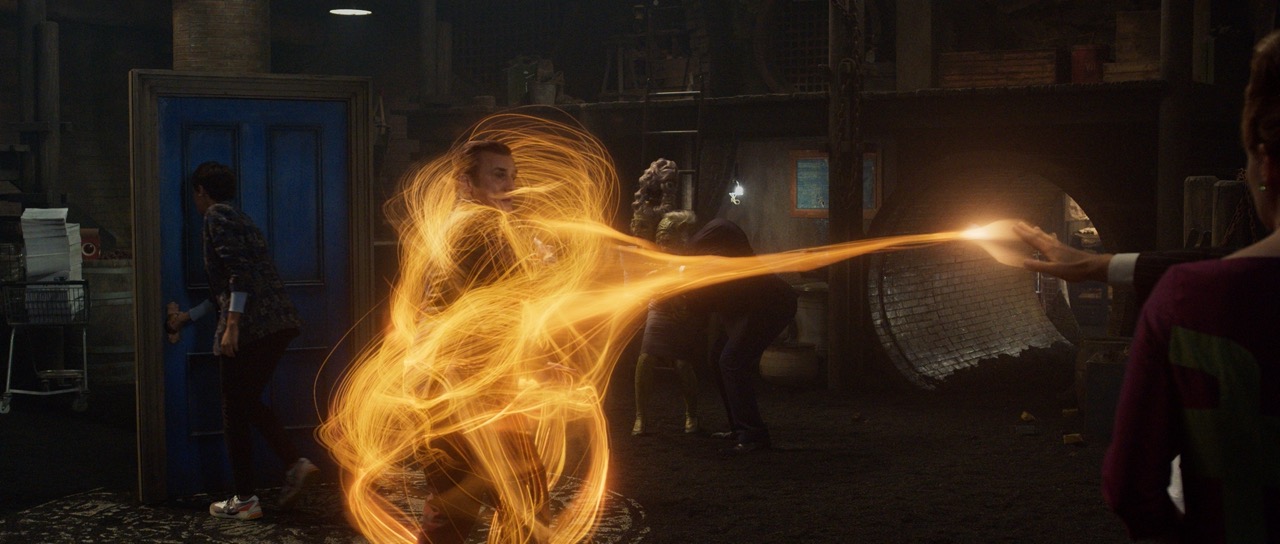
Effects that wrap around or flow across a character's body — energy bleeding into clothing, sparks tracing across skin — were built using the same approach on a much finer scale, with the curve geometry fitted to the actor's form and the noise dialled back to keep the detail subtle.
/ The Orbs
The beam toolkit turned out to be unusually flexible. For the glowing magical orb — a central weapon and object of power in the film — we combined the particle techniques with a spherical mesh as a containment volume, letting the particle energy circulate within the orb's surface rather than travel along a path. It gave the orb that sense of something alive inside it.
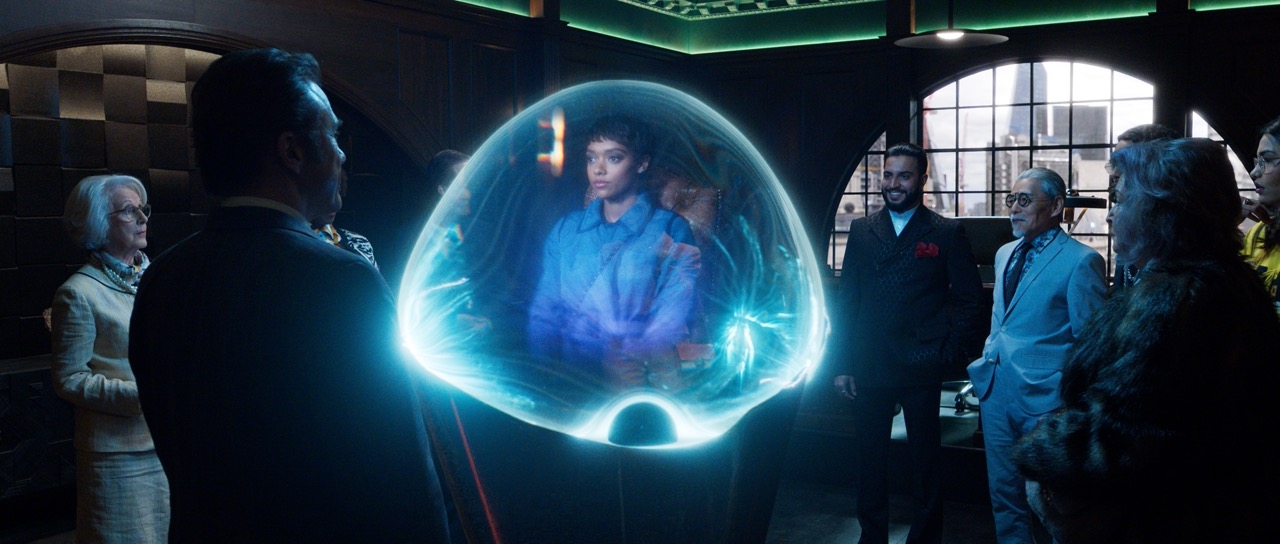
The orb work was far more varied than a single effect. Across the film, orbs were held in hands with CG interactive lighting replacing the practical light source, thrown between characters, animated splitting mid-flight, used to fire at walls and objects — a stapler, jars, a gramophone — and on one occasion countered by a character flattening the orb into a shield as it flew toward them. Another orb ricocheted off a character who hit it with a bat. Each scenario required its own animation and lighting approach, with interactive light locked to whichever actor the orb was adjacent to at any given moment. The tunnel explosion sequence combined an orb impact with a multi-plate composite: explosion plate, John Wells falling through air, goblins in foreground, and a roof extension — all married in Nuke.
/ The Tractor Beam
Separate from the orb and magic spell work was a sustained tractor beam — emanating from Humphrey's hands and locking onto Wells or Sophie across a significant number of shots. Where the orb was a projectile and the spell was a finger-tip effect, the tractor beam was a continuous, directional force. It required CG interactive lighting on every actor it contacted, tracked and animated shot by shot. The beam also appears in two-handed form — both of Humphrey's hands firing simultaneously — and eventually fails, cutting out mid-shot as a story beat. A magic freeze effect was built for one sequence where Humphrey is locked in place, body fixed to the background plate, only his eyes remaining mobile.
/ The Portable Door & The 100 Doors
The title object — the Portable Door itself — required its own sequence of effects: the door opening into a CG black void (the Nether environment composited into the green screen behind the door frame), a tractor beam hitting the open door, the door shimmering to invisibility, and a towel animating through the air and landing on a character's shoulder as it disappeared. A separate sequence showed two doors opening beneath Paul, a black void in the opening, Paul falling through from a green screen plate, the basement floor doors closing after him, and magical smoke as the doors vanished.
The 100 Doors sequence was one of the more conceptually specific briefs on the show: 100 CG doors of varying sizes, shapes and colours floating above Paul in space, re-ordering themselves and presenting closer or further as if being orchestrated by his movements. The doors had to feel like a selection being made — responsive and deliberate — while remaining visually coherent across a wide shot with tractor beam and ceiling extension also in frame.
/ Environments, Creatures & Transformations
The JW Wells building exterior was built in post: bank signage replaced with the JW Wells logotype, a dome rooftop composited with tracked lighting, three CG skyscrapers inserted into the background, and the building's founding date added in Roman numerals. London street plates — 2-3 storey period buildings with window openings — were built as full CG matte paintings to complete exterior sequences shot entirely in Australia.
A recurring visual device throughout the film was a projection system carrying Sophie's animated plate inside it — tracked, lit, and composited across many shots, with London plates outside windows and grime and reflections added to each setup. A small electrical charge effect — a mini tractor beam with a purplish tinge — crackled on and disappeared on a character's palm, with interactive light added to the hand and surrounding page.
On the creature side, CG ears grew rapidly on an actor's head across multiple close-up shots — tracked, animated, lit against HDRI reference captured on set, with the mouth guard darkened to read as a black void. Three goblins — Seth, Jessica and Stephen — were digitally scanned and their likenesses used to morph each character into a stationary object. Rosie's full goblin transformation was built as a morph between the human plate and a goblin plate, with speed ramps matched from the editorial reference.
The bookshelf sequences involved hand insertions into modelled, textured, lit objects using green screen hand elements, and a full CG bookcase wall that wrapped around actors as they physically walked through the space it occupied — a shimmering magical effect following them through and snapping back, with a CG VHS tape falling as the shelf wobbled in their wake.
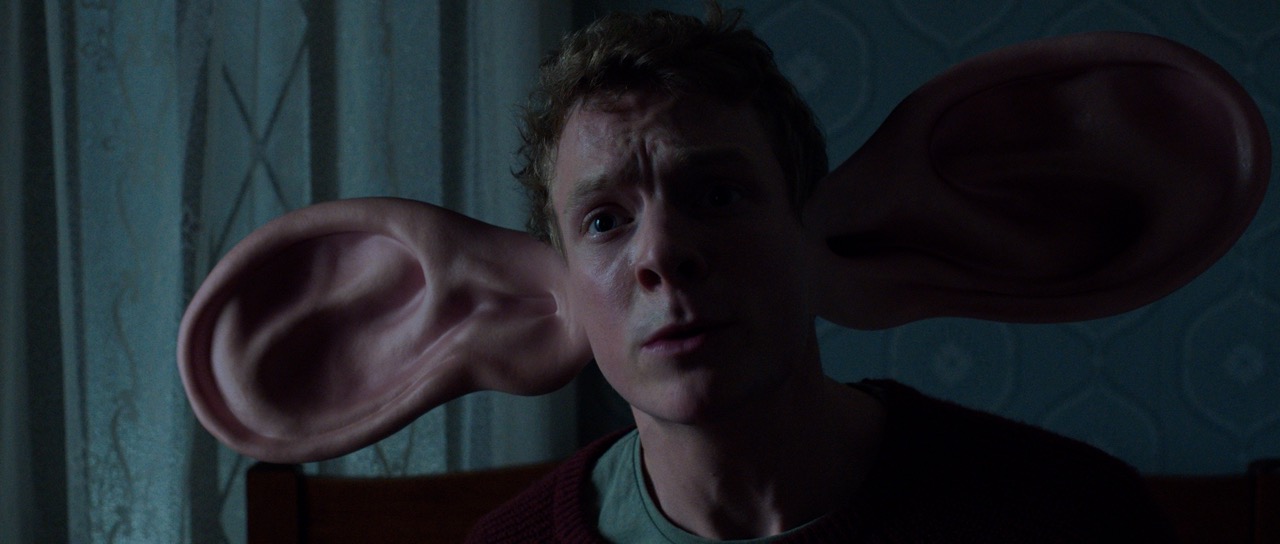
"The Portable Door had such a variety of magic effects — animated hair, giant ears, magical doorways, tractor beams, holograms and orb battles. The project really challenged us technically and creatively." — Lindsay Adams, VFX Supervisor