
A British RAF Wing Commander is shot down over the Philippines in 1942, captured, and forced to fight in a Japanese internment camp. An ambitious independent WWII action film — written and produced by Marc Clebanoff, starring Scott Adkins.
Future Associate delivered 30+ VFX shots for the production — covering aircraft animation, FX, and supporting assets. We also provided previz and on-set VFX supervision.
/ Overview
Prisoner of War is an ambitious independent WWII action film — shot on location in the Philippines with a large international cast and real period production scale. Written and produced by Marc Clebanoff, the film stars Scott Adkins as James Wright, a Wing Commander in the Royal British Air Force whose plane is shot down over the Bataan Peninsula in April 1942. Captured and brought to a Japanese internment camp, Wright is pitted in a series of increasingly brutal death matches by the camp's commanding officer, Lieutenant Colonel Ito. As Wright befriends his fellow prisoners — and fights to keep them alive — the clock is running out before the entire camp is forced onto the Bataan Death March.
Future Associate's work centred on the film's climactic escape sequence — the moment the heroes are rescued. To deliver it, we built three CG vehicles from scratch: a glider, the C-47 which was the large aircraft performing the pickup, and the Japanese Zero. Each required its own approach, its own pipeline, and its own level of scrutiny.
We love working on independent projects — particularly the ambitious ones. By collaborating closely with the producers from early in the process, we were able to make a meaningful contribution to the film and genuinely elevate its final scene.
/ C-47 Picks Up Glider
The central sequence: a C-47 performing a glider pickup, snatching the grounded glider from the field and carrying the heroes to safety. The producers wanted to get it right, and so did we.
We started with reference. Deep in the archive we found black and white footage of an actual WWII C-47 performing a glider pickup — the real thing, shot during the war. Everyone loved it. That footage became the blueprint: we set about recreating the manoeuvre and designing the shots around it.
Production built a partial glider set so actors could enter and exit — there's a scene that plays out inside. But the set couldn't move, and it wasn't complete. No wings. No tail. We photographed and scanned the partial build so we could extend it in CG. Depending on the shot, that meant adding wings, or building out a full CG glider capable of flight. We shot textures on set to keep the CG extension grounded in the real materials.
In the story, the glider has been sitting in the field for some time before the pickup. To sell that, we used Houdini FX to create vegetation draped across the grounded aircraft — overgrowth that had crept in around it, embedding it in the landscape before the sequence tears it free.
/ Previz
The director came to us with rough storyboards — the angles he wanted, the shape of the sequence. From those, we built a basic previz scene that let us quickly block out cameras, lock in focal lengths, and establish the positioning of every set piece we'd need. All of this was happening while location scouts were still underway.
The previz let us break down exactly how many VFX shots the sequence would need, and gave production a clear picture of the drone and plate photography that would have to be captured on location. After a couple of rounds of experimentation with editorial, we were able to send our on-set VFX Supervisor Stuart Willis to the Philippines — armed with the previz — to complete the location scout.
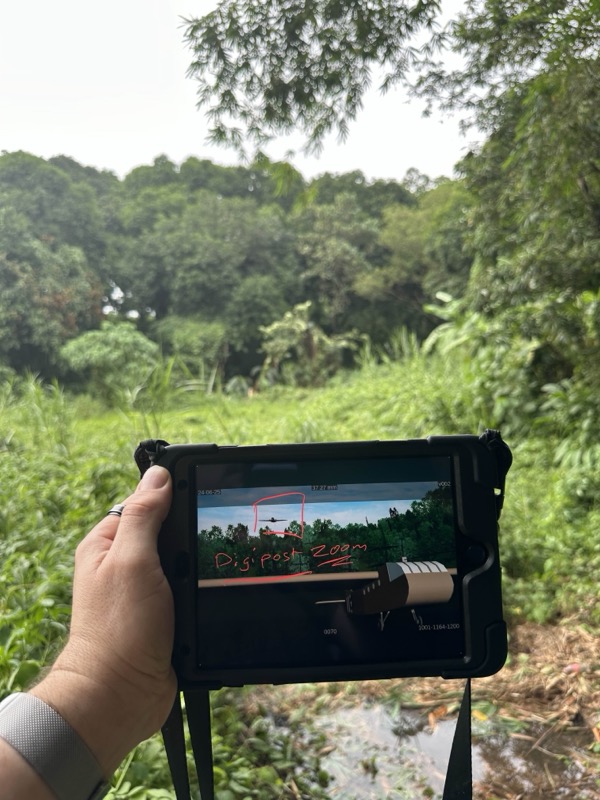
Stu on location — previz open on his iPad, working out exactly where to shoot the scene.
/ The Build
We built three hero assets for the show: the glider, the C-47, and the Japanese Zero.
The glider was extended from the partial set build — photographed, scanned, and completed in CG, with wings and a tail added depending on the shot.
For the C-47 and the Japanese Zero, we started with stock models. This lets us hit the ground running and focus effort where it matters — adding detail that will actually read on screen, rather than over-engineering geometry that will never be seen. It's a strategy we apply across all our projects, but on an indie it's a particularly important principle.
After increasing the model detail, we resurfaced both aircraft in Substance Painter, rigged and animated them in Maya, lit and rendered in Houdini with Redshift, and composited in Nuke.
"The Japanese Zero was of particular interest to me — my grandfather fought against these fighters during the bombing of Darwin in WWII." — Lindsay Adams, VFX Supervisor
Across the C-47 and the Zero we were deliberate about the propellers — getting photographically accurate motion blur was a priority. It's the kind of detail that reads subconsciously: get it wrong and something feels off, even if the audience can't tell you why.
We used Houdini FX for the vegetation around the grounded glider, the tow cable simulation during the pickup, and the signal flare the characters fire to attract the C-47. For the takeoff itself we ran a leaf and dust simulation — the debris and foliage that had settled on the wings tearing free as the glider lifts off.