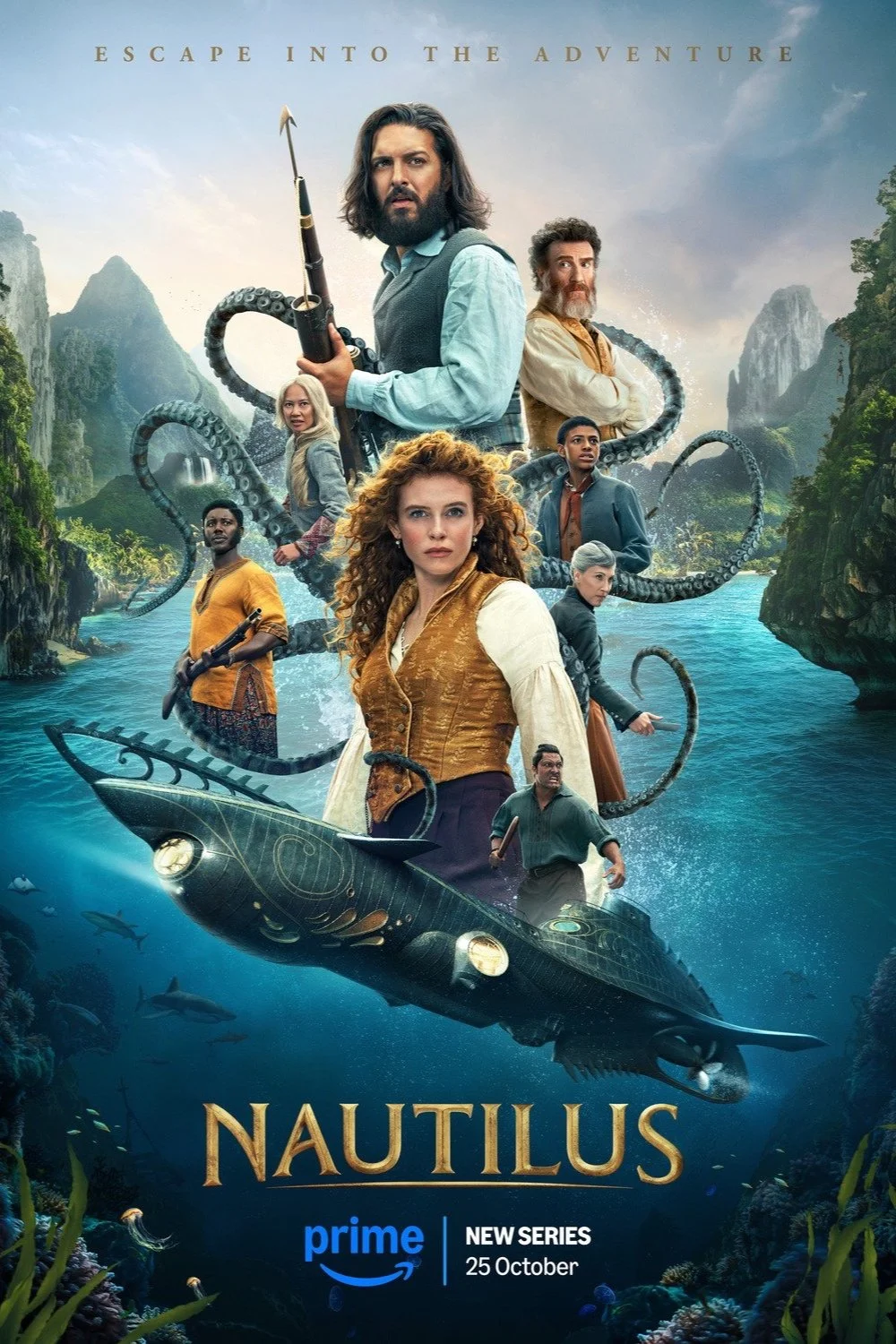
An origin story for Captain Nemo, the legendary anti-hero of Jules Verne's 20,000 Leagues Under the Sea. Produced for Disney+, Nautilus is a high-concept adventure series shot in Queensland, following a brilliant young prince turned pirate as he wages war against the colonial empire that enslaved him — aboard the world's most extraordinary submarine.
The series demanded VFX that could hold up across a wide range of environments — from intimate fire-lit interiors to expansive open ocean.
200+ VFX shots across the full series run — fire simulation with EmberGen and on-set Lidar scanning, ten distinct ocean environment looks, and advanced keying across interior and exterior sequences.
/ Fire — Simulation, Embers & Reflections
The fire sequences were the most technically demanding brief on the show. The challenge wasn't just building convincing fire — it was getting it to behave accurately within a physical space we hadn't shot in. Every volume needed to feel like it was actually in the room, pushing smoke into the right corners, catching on the right surfaces.
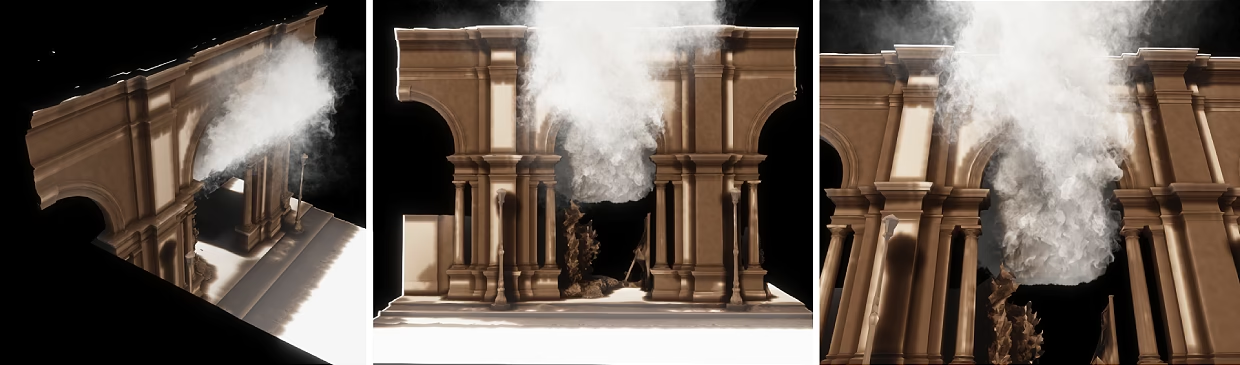
Our CG smoke was generated in EmberGen, which gives you a fast iterative workflow for volumetric effects without sacrificing quality at render. To anchor it properly, we brought in a 3D Lidar scan of the physical set — giving us an accurate geometry shell for the space so the billowing smoke volumes could interact with the architecture correctly rather than floating through it.
Beyond the main sim, fire bleeds into surfaces — and this set had a lot of high-gloss elements that needed to reflect the flame convincingly. Flame reflections on polished surfaces require a different approach to standard environment projection: the reflection moves, flickers, and changes colour temperature in a way that has to be composited with care if you want it to look integrated rather than applied.
Fire is a discipline we've built a deep pipeline around — a 30TB library of high resolution, high dynamic range fire and smoke plates, combined with EmberGen simulation and Lidar-grounded compositing. See the same approach applied to Heartbreak High S2 and La Brea S3.
/ Ocean Environment — Ten Distinct Looks
The Nautilus submarine was built practically — but the ocean outside its porthole windows existed entirely in post. Across the series, that ocean needed to look different in every episode: different depths, different water conditions, different light. We ended up developing ten distinct ocean treatments, each with its own character.
The porthole shots were captured against blue screen — actors performing in front of a lit bluescreen filling the practical porthole frame. Our job was to pull a clean key, despill the blue cast from surrounding surfaces and skin, and composite in the ocean environment. Light rays and particle simulation within the water column added depth and helped sell the scale of the submarine's position beneath the surface.
/ Keying, Despilling & Environment Work
A significant portion of the work across the series was environment-based — shots that were largely practical but needed the world beyond the frame built or extended in post. The show is set in the Victorian era, which meant period-accurate environments: city streets, ports, colonial interiors. Shots that cut well in the edit often required invisible extensions to complete the world.
Interior sequences on the Nautilus itself presented their own compositing demands — the submarine's environment was mostly practical, but continuity across angles, lighting consistency, and the integration of CG elements into the set required careful work shot by shot.
On the exterior side, environment work included period city environments where the practical location needed extending to remove modern elements or complete the frame. The despilling and warping pipeline we developed for the porthole work fed directly into these shots — once you've built a robust workflow for one class of problem, it tends to carry across the show.