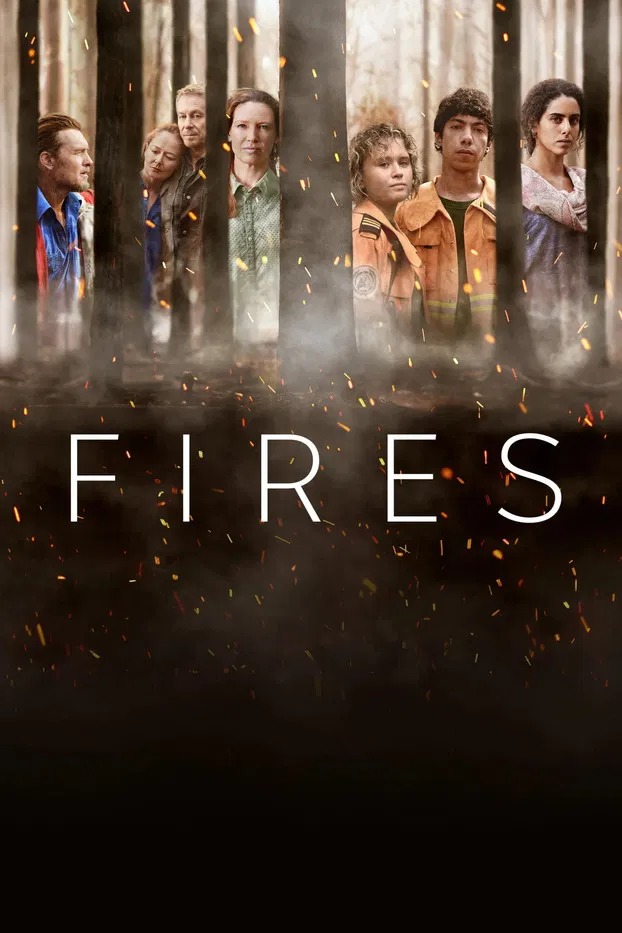
Fires is an anthology series about the 2019–2020 Black Summer bushfires, six episodes following ordinary people at the frontline as the fire makes its deadly march south, from the start of the season through to the catastrophe of Christmas and New Year. Each episode lands in a different community as the fire grows in intensity and ferocity, building to a terrifying onslaught across the country. Produced by Tony Ayres Productions for the ABC and shot in Melbourne and regional Victoria.
Future Associate delivered 300+ VFX shots across all six episodes, tracking the fire from its first contact in the burning bush through to the burnt aftermath. The work spans practical fire enhancement, full CG burning environments, a digital fire truck built for both reflection and destruction, virtual production augmentation, large-scale smoke, burnt-landscape matte painting, ember attacks, and the bushfire skies, day and night, that the series lives inside.
/ Fire You Can't Safely Light
Bushfire is one of the hardest things to put in front of a camera, because almost none of it can be lit on the day. The subject sets the constraint: you can't burn a real forest, and you can't surround your cast with an out-of-control fire front. In preproduction the production planned around what special effects could safely deliver, flame bars, blankets doused in flammable material and wrapped around tree trunks, practical smoke, and embers where it was safe to release them. That practical work gave every sequence a real, physical anchor. Everything beyond it, the scale, the spread, the intensity that reads as an actual bushfire, was ours to build.
That reliance only deepens in the edit. You shoot what you can, but once the sequence is cut together the gap between what was safe to capture and what the story needs is wide, and visual effects close it: not just the large-scale fire, smoke and embers, but the small, dangerous details that couldn't be achieved safely in front of the actors.
Fire is something we've built a deep pipeline around in the years since, our later work on La Brea S3 and Heartbreak High S2 carries the same approach forward. Underpinning all of it is our element library: around 30TB of high-resolution, high-dynamic-range fire, smoke, water and atmospheric plates, built up and carefully tagged across years of production. On a show with this kind of schedule pressure, being able to pull the exact element a shot needs, matched for flame character, height, colour temperature and motion, is a large part of what makes the combined result read as entirely physical.
/ The Fire Attack
The opening sequence is a small bushfire, with two of our heroes fighting it on the ground. Production wrapped a few trees in fire blankets as a practical base, and we built the rest of the fire around them, adding midground and foreground flame and smoke across the coverage to fill the scene out and give it depth and threat. The fire elements were drawn from our live-action library and composited shot by shot.
The firefighters work the fire with hoses, and the VFX had to respond to that. In several shots the flames visibly reduce as the water hits them, which meant the fire behaviour had to track the practical performance, dying back in the right place at the right moment rather than burning indifferently behind the action. We also extended the water itself, adding to what came from the hoses so the effort on screen reads against the fire it's fighting.
/ Inside the Truck
A long stretch of the series rides inside a fire truck driving through the burning bush, and that environment was captured with virtual production. A company called DreamScreen built an Unreal Engine environment played back on a large LED screen positioned outside the truck, with the actors performing in the cab and the fire world running live behind them.
The Unreal content held up beautifully where it belonged, soft, out of focus, sitting in the background behind the performances. The challenge was the handful of shots that look straight through the windscreen and focus on the screen itself. At that point the eye lands on the content, and it needed more than the real-time environment could give. For those shots we added fire, smoke and environmental detail directly into the Unreal imagery, building density into the exact areas the camera was scrutinising until the world beyond the glass held up to focus.
The setup created a useful in-between space, too. Production shot practical special-effects embers in the gap between the LED screen and the truck, which made for a genuinely interesting layer to work with, real embers drifting in real space in front of the actors. We added our own embers and fire into that same gap, building the density across the join so the practical and digital elements read as one continuous storm of debris.
One shot in the sequence has a tree fall directly in front of the truck. That was a full visual effects build, a falling branch with a Houdini fire simulation attached, dropping into frame and carrying its own flame as it comes down.
/ The Burnover
The set piece the truck sequence builds toward is a burnover, the moment the fire front overruns the vehicle and passes across it, staged as a big wide shot with a fully CG burning environment in every direction.
That shot needed a CG fire truck, because the vehicle had to reflect the inferno around it correctly across all of its metalwork. We started from an Isuzu stock model and built out the rear from there, the fire hoses, the rails, the housing, all the custom rig that makes an appliance truck what it is. It was an asset worth building properly, because we needed it again later in the series for the rollover, where it returns as a wrecked version of itself.
Around the truck we built a forest. SpeedTree generated a library of tree variations, which we populated into a Houdini scene and then set alight, fire mapped onto trunks in the foreground and background and through the full canopy, embers streaming across frame from screen right to screen left, ground fires burning right in front of the truck, and a generous layer of smoke threading through everything to carry the depth. The forest floor was built from Quixel Megascans, giving us organic, undulating ground underfoot rather than a flat plane. The scene was rendered in Redshift and composited in Nuke.
With the environment built, we could move the camera through it. One wide tilt-down copied the camera move directly from the on-set photography, so the CG shot sits seamlessly alongside the plates around it. For others we invented the move entirely, a long-lens shot of one fire truck backing toward another to reach the people trapped inside, given a loose, handheld pan from one vehicle to the other so it carries the urgency of the moment rather than the smoothness of a CG camera.
/ Smoke at Scale
Some of the widest shots exist to do one thing: convey the sheer scale of these fires. For those we wanted enormous, voluminous smoke, the kind of plume that dwarfs everything beneath it. We licensed stock photography of large smoke columns and mixed several together to build a single dense plume, then tracked it into the shots in 2D.
The detail inside those elements is what sells them. At that scale, bushfire smoke turns orange: the particles thicken until they cut out the blue end of the spectrum, leaving the yellows and oranges behind, with the exact hue shifting depending on how dense the smoke is and where in the cloud you're looking. We graded toward that optical reality rather than treating the smoke as neutral grey. And because a still plate planted in a moving shot betrays itself instantly, we warped the stock elements to give them subtle internal movement, billowing and drifting, alive rather than pinned in place. We came back to this technique again and again across the series.
/ The Burnt Landscape
Several episodes live in the aftermath, driving through countryside the fire has already passed through. The art department dressed the immediate areas of the set, but the moment the camera turns to the surrounding hills the devastation has to extend much further than any dressing could reach. We built that extension in the composite, effectively a digital matte painting per shot, assembled from stock photography, transforming various angles of unburnt landscape into burnt: replacing parts of hills, adding charred trees and ash across the ground.
A great deal of the transformation is colour. Pulling the green and gold out of the grass and the trees and tinting everything toward ash and brown does enormous work on its own, it changes the emotional temperature of a shot before a single burnt element is comped in. Layered on top of that grade, charcoal on the ground and burnt trees in the distance complete the picture.
The same approach carries the scene where the characters arrive at a destroyed house. The art department had built a strong practical burnt set, mangled corrugated iron, the structure gone, and dressed most of the frame. We extended it outward: burnt grass into the distance and the foreground, smoke lifting through the scene, and charred trees behind, enhancing the scale of the devastation beyond what was physically there. A burnt-out fish-and-chip shop got the same treatment, a practical set of melted corrugated iron, with the roof collapsed in and burnt trees painted into the background, the matte painting composited into the partial practical build.
/ Bushfire Skies
Main unit shot its skies as they were on the day; our job was often to turn those skies into the ones you'd actually be standing under inside a megafire. Across the series we transformed plates into burnt bushfire skies, compositing in the orange distant smoke clouds, shifting the grade to that thick, light-starved cast, and in one shot keying a 2D stock flock of birds into a sky gone orange, the birds and the smoke together transforming an ordinary plate into something harrowing.
We built these at various times of day. The daytime versions carry the sickly orange of smoke-filtered sun; the nighttime versions introduce the glow of the fire burning on the horizon, the only light in the frame. It's a look the series returns to constantly, because it's the look the event is remembered by.
/ The Ember Attack
A second major ember sequence escalates from a drift of debris into a property catching alight. Embers fall in the foreground and travel toward the characters, landing on the ground, and as the scene builds they grow larger and larger, hitting the dirt and bursting almost like mortars. Each impact starts a small spot fire, and the spot fires spread, catching the bales of hay and the dry grass until they're properly alight. A Christmas tree ignites in the middle of it before the heroes get in to put the fires out.
The sequence carries into night, where the same property's house catches fire. Production shot practical special-effects fire there, and we added flame on top to bulk it out, taking the real fire as the anchor and extending it to the scale the moment needed.
/ The Rollover
Late in the series the fire truck rolls down a hill and comes to rest badly damaged. The shot was built around a practical stunt element, the Isuzu cab, flipped upside down, with the actors performing inside it. Everything beyond that cab is the CG truck, returned from the burnover and rebuilt as a wreck: broken axles, wheels collapsed from the roll, the appliance body crumpled.
We damaged the hillside to match, adding the marks of the vehicle's descent down the slope and at the base where it stopped, with residual smoke lifting off the wreck. The practical cab grounds the actors in something real; the CG carries all the destruction that couldn't be staged around them.
/ Refuge
The series closes on its most harrowing register. A whole community gathers on a pier, taking refuge by the water as their town burns behind them. We filled the shots with large-scale moving smoke, the fire just beyond the hill, the smoke thickening until the sky turns to night in the middle of the day. It's built from the same techniques the rest of the show is made of, turned to their bleakest end: the moment a community watches its town go, and the daylight disappears.