
Based on Norman Partridge's Bram Stoker Award-winning novel, Dark Harvest is set in a small Midwestern town gripped by a deadly annual ritual. Every Halloween, teenagers armed with weapons must race across town and kill Sawtooth Jack — a monstrous entity born from the cornfields — before he reaches the local church. The one who does becomes a local legend.
Directed by David Slade for MGM, the film is a visceral, stylised creature horror that required extensive VFX to bring Sawtooth Jack and his terrifying world to life.
Future Associate delivered 200+ VFX shots across the production. The work centred on Sawtooth Jack — a hybrid creature built from in-camera performance, digital warping, and selective CG to keep the character grounded in real on-set lighting and movement.
/ The Problem
Director David Slade brought us on to solve a specific problem: how do you take an actor in costume and turn them into something that looks like skin pulled directly over bone? Sawtooth Jack's skeletal frame had to feel genuinely supernatural — not a suit, not a costume — while still carrying the weight and movement of a real performance.
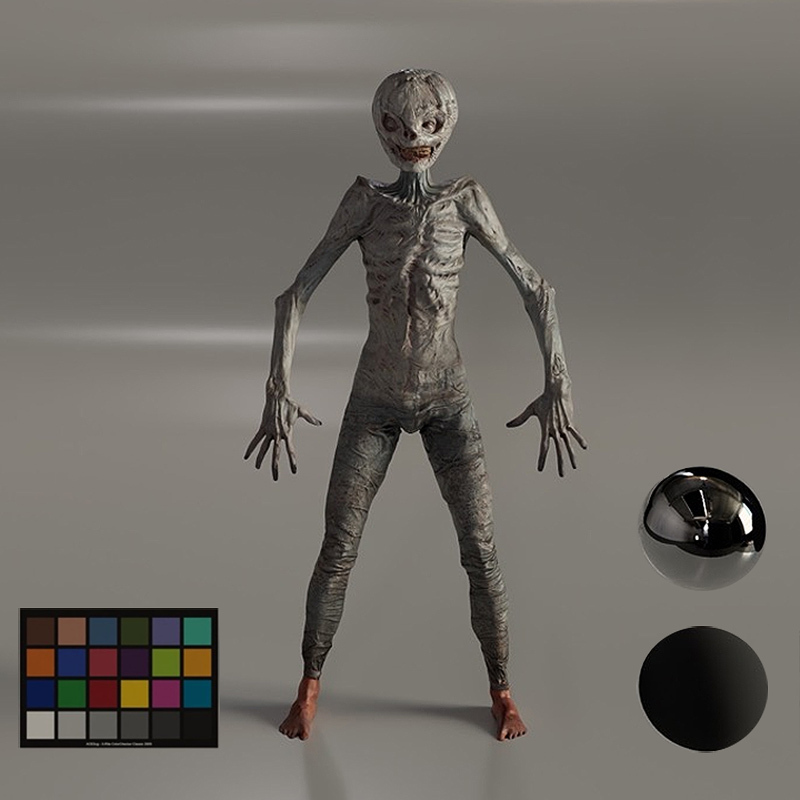
The answer wasn't a full CG replacement. That path tends to read as CG. We needed something that preserved the in-camera reality of what was shot, while fundamentally warping the human form into something else.
/ The Warp Approach
We received 3D scans of the actor in full costume and used them to build a warp model — digitally sculpting the humanoid form into Sawtooth Jack's skeletal proportions. That model was then used to deform the original plate footage rather than replace it. In-camera lighting, movement, and performance are preserved because you're still working with what was actually shot. A BlendShape setup in Nuke drove the warp, with CG patches only applied where the deformation alone wasn't reading cleanly.
The result is a character that exists on a spectrum: some shots fully CG, others almost entirely in-camera. We used as much or as little as each shot required. The approach kept the VFX count manageable without sacrificing the creature's physical presence.
/ Light & Integration
On top of the warp, we composited additional CG elements: a glowing head, fire, and close-up facial animations for the more intimate moments. Each new light source had to be reconciled with the rest of the body — a glowing head throws light onto shoulders and chest that were previously in shadow, and that has to be painted back in convincingly.
One key scene required particular attention. The light from Jack's head now illuminated parts of his shoulders and upper chest that had been in shadow during the shoot. After several rounds of feedback, we landed on leaving the hands and pants untouched, warping the torso and chest, and adding CG for the more angular shoulders, arms, underarms and sides.
Chrome balls, LiDAR scans, clean plates, and stunt performer reference footage were all used throughout to lock the lighting integration — giving the compositing team the data needed to make each CG element read as part of the same scene.