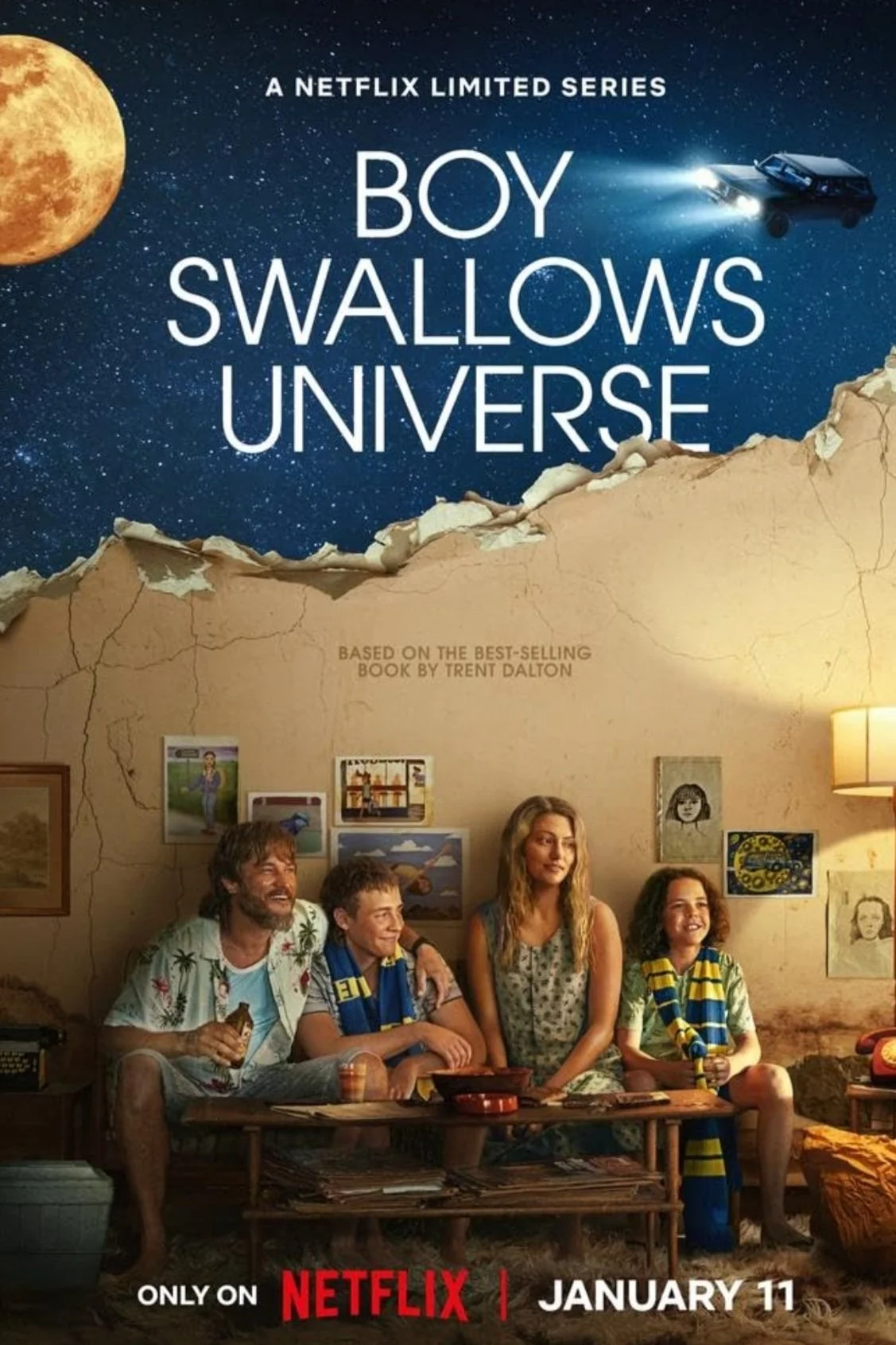
Based on Trent Dalton's bestselling novel, Boy Swallows Universe is the story of Eli Bell — a boy navigating a chaotic 1980s Brisbane childhood of crime, love, and survival. Netflix's most-watched Australian-made production to date, the series ran for seven episodes and landed in Netflix's global Top 10 for three consecutive weeks on release.
Shot entirely in Queensland, the production required Future Associate's VFX work across the full series run — from intimate character moments to large-scale fantastical sequences.
350 shots across all seven episodes, supervised by Lindsay Adams. Dream sequences, a fully CGI Blue Wren, Houdini vapour text simulation, water FX, and a complete clocktower sequence — built from on-set consultation in mid-2022 through to delivery in August 2023.
/ Dream Sequences — Holden Kingswood in Space
Recurring throughout the series, Eli and Gus drift through space in a Holden Kingswood — the family car as a vessel for the boys' shared imagination. These sequences were one of the bigger undertakings on the show: we needed to deliver a credible weightless environment while keeping the aesthetic feeling handmade rather than polished.
Production rigged the Kingswood on set and shot it against blue screen, manoeuvring the car to replicate the movement of floating. For closer shots and moments where the action was contained, we worked with that blue screen footage — extracting the car and placing it into a CG space environment. The wider shots, where the full scale of the scene needed to read, were built as entirely computer-generated sequences. Both approaches were composited to match across cuts, so the transition between live action and full CG holds without calling attention to itself.
/ Vapour Text — Houdini Smoke Simulation
The vapour text is the most technically involved effect on the show. Gus writes messages to his brother Eli — words that hang in the air as wispy smoke trails, visible to the audience and to Eli, but existing somewhere between the physical world and the boys' inner lives. The effect needed to feel organic: like smoke behaving almost purposefully rather than a particle system doing what it was told.
The entire setup was built in Houdini across three interconnected systems.
The first is the suction target system. Rather than use a font, we hand-drew each word on a Wacom tablet to give the writing a natural, non-repeating character — each letter unique the way handwriting is. Those drawn curves were processed through a For Each End loop using a carve node, which controls the reveal timing so the words appear in the order they were drawn and allows individual words to have different pacing. From those curves we generated two outputs: a three-dimensional version of the written words with added thickness, which acts as a containment volume for the smoke; and a moving endpoint — the equivalent of the tip of a pen — that tracks the leading edge of the writing as it forms.
The second system is the pyro force target micro solver. This takes the endpoint from the suction target system and uses it as an emission source — smoke is generated at the tip and moves along the path of the writing as the words are drawn out. The 3D thickened word shapes then act as a suction target, pulling the smoke into the letter forms and trapping it there. Inside that containment volume, the smoke develops natural vorticity — it moves continuously, never sitting static, which gives the effect its alive quality.
The third system is a pop advection simulation. We took the original drawn curves — animated through the For Each End process — and duplicated them five times, applying different animated noise to each copy to give the lines an organic squiggly movement. Those lines were spun at high velocity, passed through curl noise, and used as the emission source for a particle sim. The particles inherit velocities from the pyro simulation via advection, so their movement follows the smoke rather than existing independently. Finally, the particle sim was converted to a volume, rendered, and handed to compositing for integration into the final shot.
/ The Blue Wren — Fully CGI Bird
A Splendid Fairy-wren appears throughout the series as an omen — small, specific, carrying meaning in its presence. Working with live animals across a seven-episode schedule wasn't practical, so we built one.
Production provided a large reference package: stills, video reference and detailed notes on the bird's movement and colouring. From that, we constructed a fully CGI wren — modelled, rigged and animated to match the performance needed for each shot. On set, physical scaled models were placed in the correct positions in frame to give the director and DP accurate reference for lighting and blocking. We painted those models out in post and inserted the digital bird in their place. The result is a creature that behaves like it was actually there, because the production was designed around it being there.
/ Water Simulations
The series has a number of water-heavy sequences that required simulation work. A CGI splashing fish needed to read as fully physical — water interaction, surface displacement, the specific way a fish breaks the surface and re-enters. We also handled a car crash into a lake, which required fluid dynamics at a different scale: the vehicle displacing water on impact, the spread of the splash, the settling of the surface after the fact.
Both were Houdini FX simulations. The fish interaction was the more delicate of the two — scale and timing had to be tight for the creature to feel real at the size it appears on screen. The car crash gave us more room to work with physically, but demanded consistency across multiple cuts to keep the sequence geographically coherent.
/ The Clocktower
The series finale centres on a clocktower sequence that required significant VFX to deliver. The work included blue screen replacement to extend and contextualise the environment, procedural shattering glass simulation for a key moment of destruction, and body physics simulation for character movement that couldn't be safely achieved practically. These three elements were composited together in Nuke, with careful attention to lighting consistency between the blue screen plates, the CG destruction and the live action elements on set.